
Attackers Already Did This Research on Your Target
Every acquisition target has an external footprint it does not control. Forgotten domains from a rebrand, credentials sitting in an infostealer log, API documentation published to the open internet. That footprint is free to collect and someone already has.
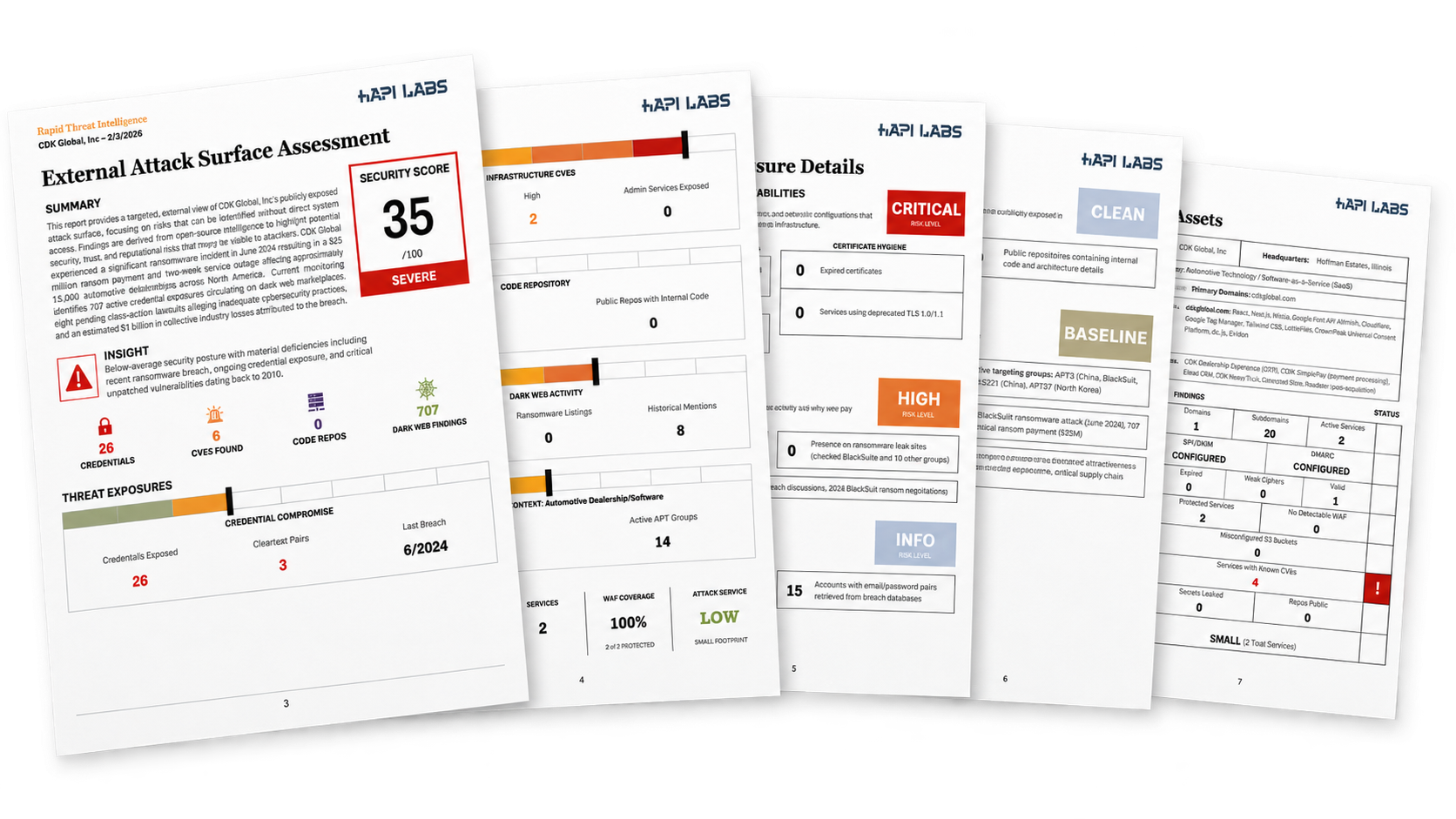
Our Rapid Threat Intelligence service provides an outside-in exposure review requiring no access or cooperation from the target, mapping its external attack surface and evidence of prior compromise, giving you a threat picture before a deal closes.

Rapid Threat Intelligence
Intelligence without access
Rapid Threat Intelligence runs entirely from outside the target's perimeter using the same sources an attacker uses. It is the assessment you can run before the LOI, before the data room, and before anyone at the target knows a deal exists.
Our Edge:

Seventeen source classes collected, from certificate transparency and passive DNS to infostealer infection logs, ransomware leak sites, litigation records, and published API specifications.

Confirmed exposures only. A finding is retrieved or verified by an automated check. Nothing reaches the report inferred from a banner, a name match, or a vendor's clustering.

Coverage is stated, not implied. The report names the sources that returned nothing and the sources that could not be checked, alongside the ones that produced findings.

Legacy domains stay in scope. Corporate history drives the collection list, so a rebrand or a prior acquisition does not retire the exposure it left behind.
Clear, High-Value Deliverables
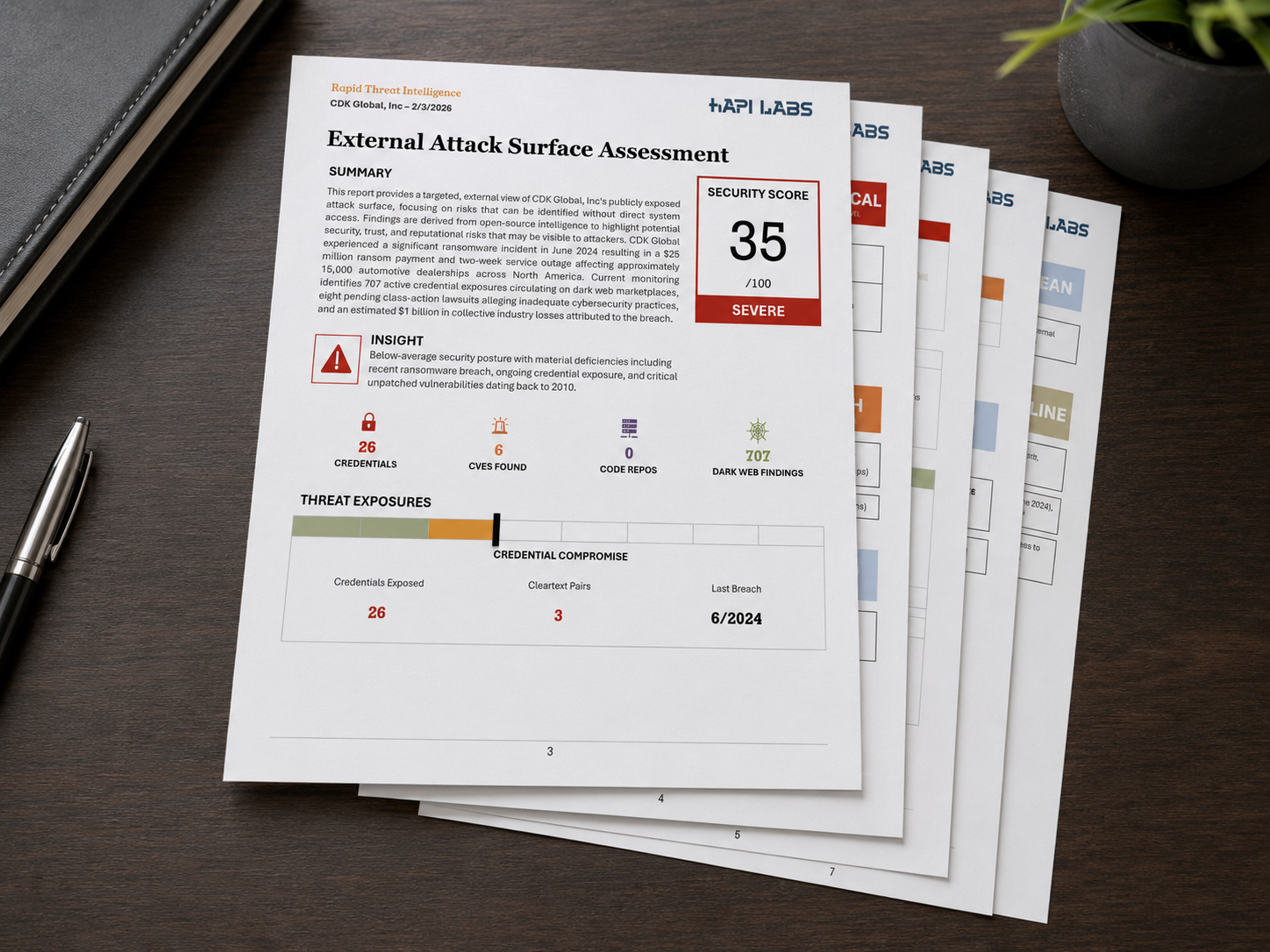
One report that opens with a plain-language summary that reads without a security background, and carries the full technical detail behind it. Every count arrives with its denominator. Every finding states what was observed and what confirmed it. The collection coverage, the open leads that are not yet confirmed, and the limits of what outside-in collection can see are all in there.
Built for the Window Before Access
Rapid Threat Intelligence is run by:

Private equity firms screening targets before the LOI, when environment access is not on the table
Deal teams testing a target's security claims against externally observable facts

Acquirers baselining a portfolio company they already own

All with one outcome: the facts an attacker already has, in your hands before the transaction assumes they do not exist.
The Exposure Transfers With the Company
A credential leaked in an old breach is only harmless if someone rotated it. An infostealer infection on an employee machine is an active compromise, and on the day the deal closes it becomes yours. Neither one appears in a financial diligence pack, and neither one waits for the integration roadmap.
What a Security Rating Will Not Tell You
| Security Rating Platform | Rapid Threat Intelligence | |
|---|---|---|
| Basis of a finding | Inferred from scan output and third-party datasets | Retrieved directly or confirmed by an automated check |
| Asset attribution | Name similarity, DNS resemblance, shared hosting | Registry identifier, zone chain, or certificate SAN, confirmed by a human on every finding |
| Predecessor domains | Current domain only | Corporate history drives the collection list |
| Application surface | Sampled from the outside | JavaScript bundles, source maps, developer portals, and published specifications read in full |
| Credential exposure | Breach dump counts | Active infostealer infection reported separately from old breach records |
| Sources that found nothing | Not shown | Named in the report |
| Output | A number | Findings with evidence, denominators, and the open leads that are not yet confirmed |
How the Service Runs
-

Non-Interference by Design
Default collection sends nothing to the target. Reading the public site is indistinguishable from an ordinary visitor loading a page. A directed request to an unlinked path requires your written authorization, a declared rate ceiling, and an attribution header identifying us. Anything past that is out of scope for this service and routes to a penetration test.
-
What We Refuse to Report
Missing headers on API-only endpoints, banner-guessed CVEs, and generated email addresses presented as exposure counts do not become findings here. Every count in the report carries its denominator, because a raw number invites the reader to supply one and they will get it wrong.
-

The Decision Stays Yours
The report states what was found and what it took to confirm it. It does not tell you to proceed, to walk away, or to reprice, and it does not grade the target's competence. Decisions about the transaction, the valuation, and the acceptance of any risk described belong to you.

Screen the Target Before You Sign
Get in touch today for a free quote.